If you live in Oklahoma long enough, you're eventually forced to pick a side. It's the Sooner State's version of Beatles vs. Stones or Coke vs. Pepsi.
We're talking about the I-44 rivalry. The Turnpike Tussle. Oklahoma City vs. Tulsa.
For outsiders looking to move to Oklahoma, the two cities might seem interchangeable on a map - just two mid-sized metros separated by ninety miles of toll road. But for locals, the cultural chasm between OKC and "T-Town" is vast.
At BestInOkc.com, we obviously love the 405, but we believe in giving credit where it's due. To help you decide where to plant your roots, we're ditching the Chamber of Commerce fluff and giving you an objective, boots-on-the-ground perspective on real life in Oklahoma's two powerhouse cities.
Here is the definitive breakdown of the OKC vs. Tulsa living experience.
The "Vibe": Prairie Sprawl vs. Green Country Charm
Oklahoma City: The Big League Aspirant
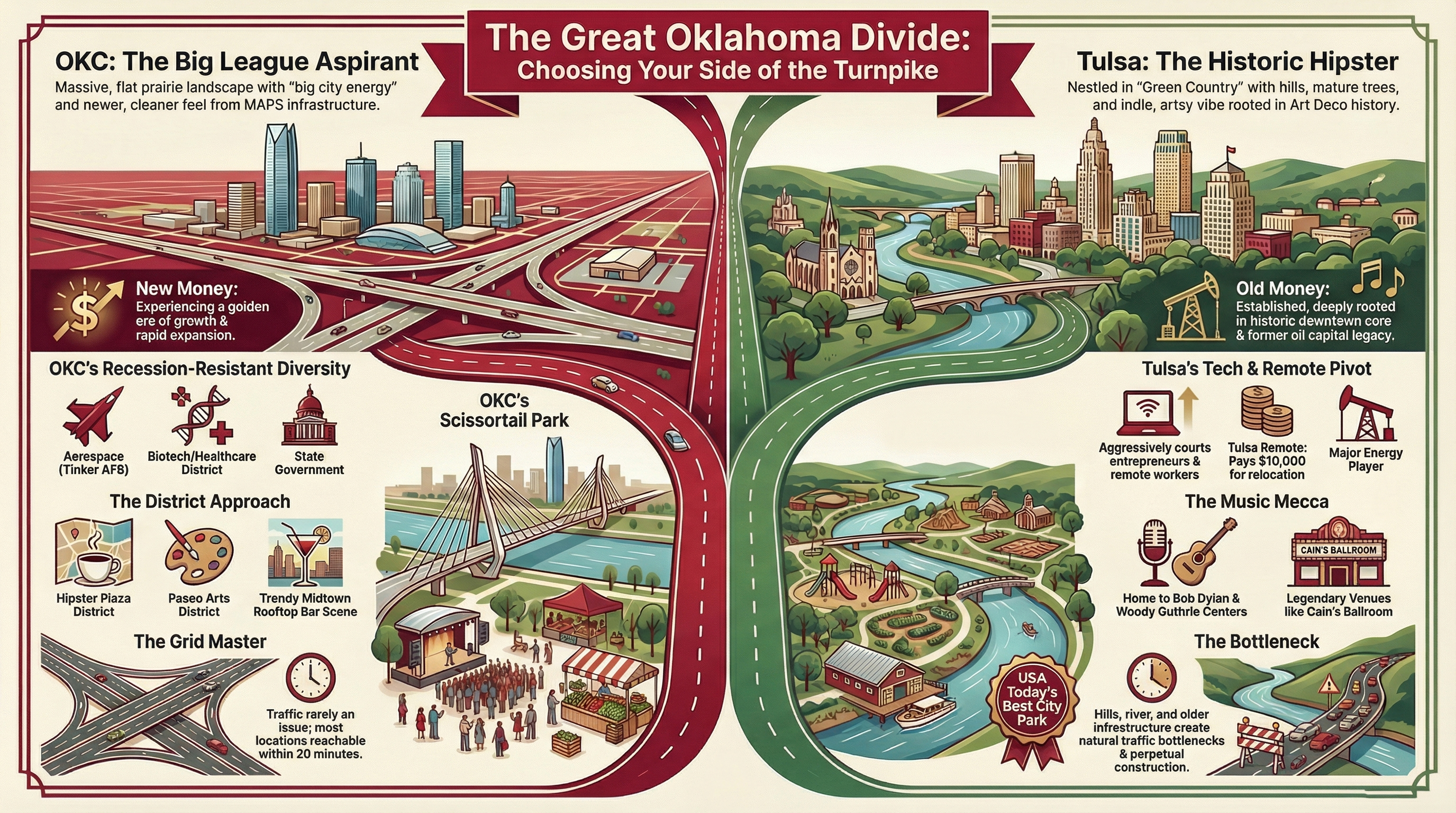
OKC feels bigger because, geographically, it is massive. It is one of the largest cities by land area in the United States. It sits squarely on the Great Plains. It is flat, wide open, and incredibly spread out.
Thanks to decades of MAPS (Metropolitan Area Projects) funding - a citizen-voted sales tax initiative that revitalized the city - OKC feels newer, cleaner, and incredibly infrastructure-focused. It has "big city energy." There is a palpable feeling that OKC is currently experiencing its golden era of growth, constantly chasing that next-tier metropolis status.
Tulsa: The Historic Hipster
Tulsa is located in "Green Country," the northeast corner of the state where the plains meet the Ozark foothills. It is noticeably greener, hillier, and boasts many more mature trees than its western rival.
If OKC is new money, Tulsa is old money. Tulsa was once the "Oil Capital of the World," and that history is visible in its stunning downtown Art Deco architecture, which rivals cities like Chicago or New York. The vibe in Tulsa is often described as more indie, artsy, and a little grittier. It feels deeper rooted in history, with a denser downtown core that feels more established, if sometimes a bit rougher around the edges.
Choose OKC if: You love wide-open skies, modern infrastructure, and the energy of a city that is rapidly expanding.
Choose Tulsa if: You prefer hills, mature trees, historic architecture, and a slightly more relaxed, artsy atmosphere.
The Hustle: Economy and Job Market
Both cities offer incredible value compared to coastal metros, but their economic engines run on different fuels.
OKC: The Diverse Powerhouse
OKC's economy is famously recession-resistant because it is diverse.
- Government: As the state capital, state and federal jobs are abundant.
- Aerospace/Defense: Tinker Air Force Base is the state's largest single-site employer, creating a massive aerospace sector.
- Energy & Biotech: While still heavily tied to oil and gas (Devon Energy, Chesapeake), OKC has successfully diversified into biotech and healthcare in areas like the Oklahoma Health Center district.
Tulsa: The Remote Hub and Tech Pivot
Tulsa's roots are deep in energy, but it has recognized the need to pivot. While oil and gas jobs are still major players, Tulsa has made national headlines with innovative programs like Tulsa Remote, which pays remote workers upwards of $10,000 to relocate to the city. This has injected a young, tech-savvy demographic into the city center. Tulsa is aggressively courting tech startups and entrepreneurs.
Choose OKC if: You are looking for stability in government, aerospace, or healthcare sectors.
Choose Tulsa if: You are a remote worker looking for incentives or an entrepreneur seeking a burgeoning startup community.
The Fun Stuff: Nightlife, Arts, and Culture
Where do you go when the laptop closes on Friday at 5:00 PM?
OKC: The District Approach
Because OKC is sprawling, its culture is compartmentalized into distinct districts that require driving between them.
- Bricktown: The tourist hub with the canal and ballpark. Great for visitors, but locals often gravitate elsewhere.
- The Plaza District & Paseo Arts District: These are the walkable, hipster havens filled with local breweries, art galleries, vintage shops, and incredible local dining.
- Midtown: Trendy, slightly upscale, and home to great rooftop bars and food halls.
Tulsa: The Music Mecca
Tulsa's cultural identity is deeply tied to music. It is home to the Bob Dylan Center and the Woody Guthrie Center.
The Tulsa Arts District (formerly Brady) is the heartbeat of Tulsa nightlife. It houses legendary venues like Cain's Ballroom, a historic dance hall that attracts national touring acts you wouldn't expect in a city this size.
Cherry Street & Brookside offer walkable stretches of upscale dining, patios, and boutique shopping that feel denser than OKC's districts.
Choose OKC if: You like exploring distinct, curated districts with modern dining and brewery scenes.
Choose Tulsa if: Live music is your lifeblood and you appreciate a grittier, historic bar scene.
The Battle of the Parks: Scissortail vs. The Gathering Place
This is the newest front in the rivalry, and both cities have brought massive artillery.
Tulsa: The Gathering Place
Let's be objective: Tulsa currently holds the crown here. The Gathering Place is not just a great park for Oklahoma; it was named USA Today's Best City Park in the nation. It is a massive, unbelievably detailed $465 million riverfront park that feels like Disney World without the mouse. For families, it is an absolute game-changer.
OKC: Scissortail Park
OKC fired back with Scissortail Park. It is stunning, modern, connects directly to downtown, and features a great concert venue and weekly farmers markets. It is a spectacular urban park that transformed the city center.
Getting Around: Traffic and Infrastructure
OKC: The Grid Master
Because OKC was laid out on a massive grid and has wide highways, traffic congestion is rarely an issue compared to other major cities. You can get just about anywhere in the metro in 20 minutes. It is incredibly easy to navigate.
Tulsa: The Bottleneck
Tulsa's geography (the river and hills) and older infrastructure create more natural bottlenecks. Construction seems perpetual on key arteries like I-44 through the city. While traffic isn't "LA bad," Tulsa drivers spend more time tapping their brakes than their OKC counterparts.
The Final Call: Which OK is OK for You?
The truth is, the "OKC vs. Tulsa" debate is a win-win scenario. Both cities offer a cost of living that lets you actually save money, friendly populations, and cultural scenes that punch way above their weight class.
If you want a city that feels newer, bigger, easier to drive in, and has a diverse, stable job market with a polished aesthetic, OKC is your spot.
If you want mature trees, historic architecture, hills, a legendary live music scene, and access to the best park in the country, Tulsa is calling your name.
Whichever side of the turnpike you choose, you're getting a great version of life in Oklahoma.
More from The Vibe
Did you enjoy this story?
Share it with your friends or explore more from Vibe Magazine.