


Oklahoma City is not a college town. Norman is. Stillwater is. But OKC—the state capital, the metro of 1.4 million, the "Big Friendly"—sits squarely between OU and OSU, and that geography creates a different kind of identity question: not "Are we a university city?" but "Whose city is this—crimson or orange?"
The answer is both, neither, and it's complicated. Bedlam on the field and split allegiances in the stands define Oklahoma City as the place where the state's two flagship universities meet.
To understand why OKC ended up in this role, you have to go back to the beginning: how the Oklahoma Territory got two major universities in the same year, and how the capital city became the shared ground for both.
How Oklahoma Got Two Flagship Universities (In the Same Year)
Most states have one flagship and one land-grant. Oklahoma did it in one stroke.
The University of Oklahoma: 1890
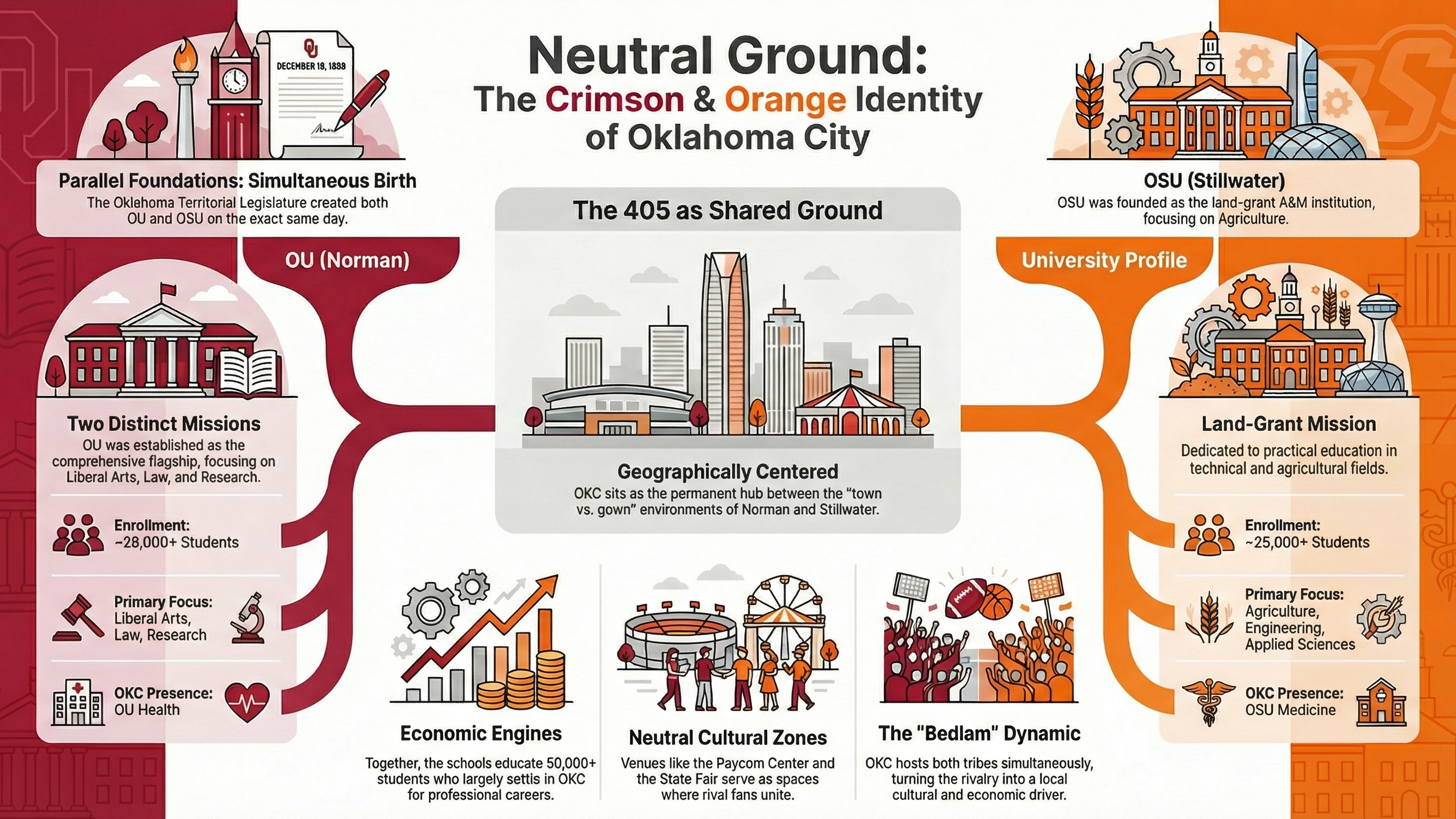
On December 19, 1890, the Oklahoma Territorial Legislature created the university that would become OU—originally Norman Territorial University—in Norman, a town just south of where Oklahoma City would grow. The first president, David Ross Boyd, arrived in Norman in August 1892; the first students enrolled that September. When Oklahoma achieved statehood in 1907, OU automatically became the state university: comprehensive, liberal arts and sciences, law, medicine, and the flagship identity that still defines Norman today.
Oklahoma Agricultural and Mechanical College (OSU): 1890
On the same day in December 1890, the territorial legislature approved an agricultural and mechanical school at Stillwater—the land-grant institution that would become Oklahoma State University. That gave the territory (and later the state) two distinct missions: OU as the comprehensive state university, OSU as the A&M land-grant focused on agriculture, engineering, and applied sciences. Central State Normal School in Edmond was also created that year, rounding out a three-school system from the start.
So Oklahoma didn't get "two universities in one town." It got two universities in two towns, with the capital—OKC—sitting between them. That's why the identity question in the 405 isn't "town vs. gown." It's "Which shade of red do you wear?"
The Numbers That Define the State
Rough order of scale:
OKC doesn't turn over with the academic calendar the way Norman or Stillwater does. It's the permanent hub—the place where OU and OSU alumni both settle and Bedlam is argued in every bar.
Bedlam: The Rivalry That Divides (and Unites) the 405
That rivalry also drives donations, enrollment, and pride on both sides. OU and OSU aren't just schools; they're tribes. And in OKC, the tribes share the same city.
OKC as the Shared Space
Oklahoma City is where both universes meet in practice:
So OKC's "identity" isn't confusion—it's neutral ground. The city is the capital, the jobs center, and the place where you can wear crimson or orange and still call it home.
The Economic Reality: Two Engines, One Metro
OU and OSU together employ tens of thousands and educate over 50,000 students. A huge share of their alumni stay in Oklahoma—and a huge share of those land in OKC. The metro benefits from both: OU Health, OSU extension and ag outreach, research partnerships, and the constant flow of graduates into OKC jobs. The state's identity isn't "OU city" or "OSU city"; it's "Oklahoma City is where the state does business—and both schools feed it."
How Oklahoma Compares to Other States
The Soul of the 405 Is the Rivalry—and the Truce
Can a city be both OU and OSU? In OKC, the answer is yes. The soul of the 405 isn't confusion—it's Bedlam on Saturday and brunch on Sunday. It's the bar where half the crowd wears crimson and half wears orange, and everyone still roots for the Thunder. It's the understanding that Oklahoma City doesn't have to choose. It's the capital. It's the Big Friendly. And it's the place where OU and OSU both belong.
More from The Vibe


Did you enjoy this story?
Share it with your friends or explore more from Vibe Magazine.