
The Case for Relocating to OKC: Affordable Living, a Growing Market, and a Community That Has Your Back
They call it "The Big Friendly" ??? and once you spend a little time here, you'll understand why. Oklahoma City has been quietly building the kind of life that coastal cities charge a premium for: a thriving downtown, real career momentum, a tight-knit community feel, and housing prices that won't keep you up at night. More and more people are noticing. Whether you're escaping sky-high rent in Austin, chasing a new opportunity, or simply ready for a city that works harder for your dollar, OKC deserves a serious look.
Here's the full picture ??? what makes this city so compelling, and what you need to know before you make the move.
Your Dollar Goes Further Here Than Almost Anywhere Else
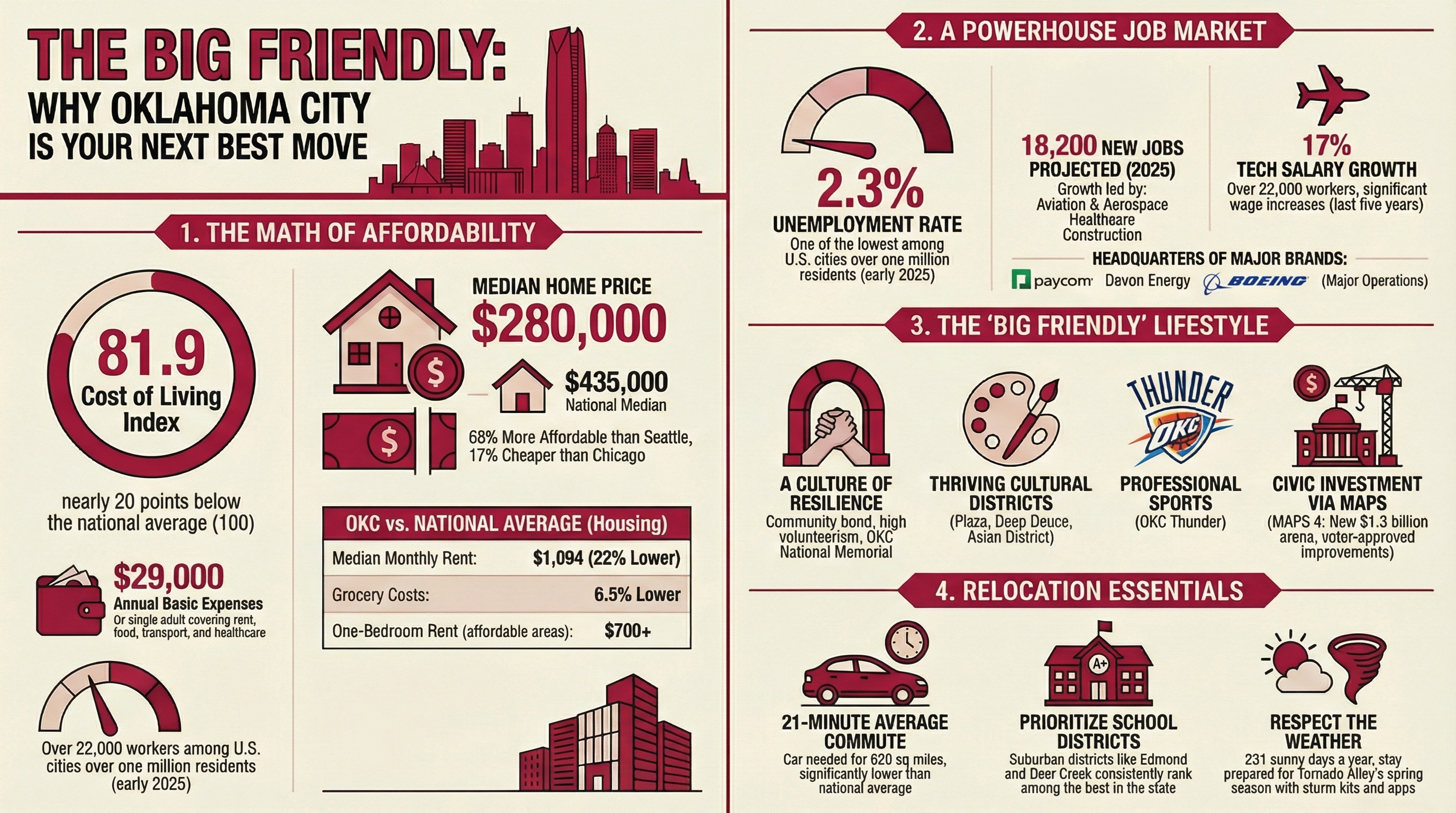
Let's start with the number that stops most people in their tracks: OKC's overall cost of living sits at 81.9 on the C2ER Cost of Living Index, where 100 is the national average. That puts it nearly 20 points below the rest of the country and ranks it among the top 10 most affordable urban areas in the entire U.S. ??? and, notably, first among cities with more than 500,000 residents.
Housing is where the math really gets interesting. The median rent across all apartment sizes in OKC lands around $1,094 per month ??? roughly 22% below the national average. One-bedrooms can be found for as low as $700 in more affordable neighborhoods, and even OKC's pricier areas like Nichols Hills or Edmond remain dramatically more affordable than comparable suburbs in other major metros. Thinking about buying? The median home price in OKC hovers around $280,000, compared to a national median closer to $435,000. For first-time buyers especially, OKC is one of the most accessible markets in the country.
And the savings don't stop at housing. Grocery costs run about 6.5% below the national average. Utilities are slightly below average too, thanks in part to some of the lowest residential energy rates in the region. Entertainment, clothing, and personal services all come in meaningfully cheaper than what you'd find in most major cities. When you add it all up, a single adult in OKC can cover basic annual living expenses ??? rent, food, transportation, healthcare ??? for roughly $29,000 a year. That kind of breathing room is rare.
For anyone moving from a high-cost city, the contrast is stark. OKC housing is 68% more affordable than Seattle's. Compared to Boston, the overall cost of living is nearly 60% lower. Even relative to Chicago, you're looking at spending about 17% less. The math doesn't just pencil out ??? it changes lives.
A Job Market That's Actually Delivering
Affordability would mean a lot less if OKC's job market couldn't back it up. Fortunately, the economic story here is one of steady, diversified growth that has outperformed national trends for years running.
The Oklahoma City metro area currently holds one of the lowest unemployment rates among all U.S. cities with a population over one million ??? sitting at just 2.3% as of early 2025, compared to a national average hovering above 4%. The metro finished 2024 with an annual average unemployment rate of 3.2%, marking 41 consecutive months below 4%. That kind of consistency reflects real structural strength, not just a good quarter.
In 2024, the OKC metro added roughly 14,700 nonfarm jobs ??? a 2.1% year-over-year increase. The 2025 Greater Oklahoma City Economic Outlook, published by the Greater Oklahoma City Chamber, projected an additional 18,200 jobs to be added this year, led by growth in education and healthcare, construction, leisure and hospitality, and oil and gas. Statewide, Oklahoma is expected to add about 42,000 jobs in 2025 overall, growing at more than twice the projected national rate.
The industries driving that growth are worth understanding. Aviation and aerospace have emerged as OKC's largest economic sector by both employment and impact ??? and it's not just Tinker Air Force Base, though the base alone is one of the largest employers in the state. Energy, bioscience, logistics, and a rapidly expanding technology sector round out an economy that's more diversified than many outsiders expect. OKC's tech industry employs more than 22,000 workers and has seen salaries grow by about 17% over the past five years. Major employers across sectors include Devon Energy, Boeing, Hobby Lobby, INTEGRIS Health, and Paycom ??? whose global headquarters call OKC home.
For entrepreneurs and small business owners, the case is equally strong. OKC is consistently ranked among the least risky cities to start a business in the U.S., thanks to low operating costs, a collaborative civic culture, and a local government that has worked hard to attract and retain investment. As of late 2025, more than 120 companies were actively considering relocating to or expanding in the Greater Oklahoma City region ??? with manufacturing, aerospace, and distribution leading the way.
A Community That Feels Like Home
Numbers only tell part of the story. What draws people to OKC ??? and keeps them ??? is harder to quantify but very easy to feel.
Oklahoma City has a warmth and accessibility that's genuinely uncommon for a metro area of its size. Locals are known for striking up conversations with strangers, holding doors, and going out of their way to help newcomers find their footing. The nickname "The Big Friendly" wasn't invented by a marketing team ??? it emerged organically from the way people actually treat each other here.
The city's community character runs deep. OKC came together with remarkable unity after the 1995 bombing of the Alfred P. Murrah Federal Building, and that shared history of resilience continues to shape how people here show up for each other. The Oklahoma City National Memorial & Museum stands not just as a monument to tragedy, but as a living symbol of what this community is made of.
That spirit shows up in everyday ways too. Neighborhood associations are active. Volunteerism rates are high. Local events ??? from the Paseo Arts Festival to the State Fair to neighborhood block parties ??? draw real, repeat participation rather than just a social media scroll. The OKC Thunder have played an outsized role in building civic pride, bringing the city together around something shared that transcends demographics.
The city is also more culturally diverse and creatively vibrant than most people expect. Deep Deuce, a historically Black neighborhood just north of Bricktown, has deep roots in the blues and jazz traditions that shaped American music. The Asian District along Classen Boulevard offers some of the city's most beloved food and a rich immigrant community story. The Plaza District and Paseo Arts District pulse with local galleries, independent shops, live music, and murals. The deadCenter Film Festival brings independent cinema to OKC each year and has built a national reputation. This isn't a city without culture ??? it's a city whose culture you have to slow down enough to actually find.
What to Know Before You Move
Every city has its quirks and realities. Here's what people who've made the move wish they'd known before arriving.
You will need a car. OKC is a sprawling city ??? 620 square miles, one of the largest city footprints in the country by land area. Public transportation exists (Embark operates a bus network), but it's not built for car-free living. The good news: the average one-way commute in OKC is just 21 minutes, well below the national average of 26.4 minutes. And gas here tends to run cheaper than most of the country.
Oklahoma weather is its own experience. OKC averages 231 sunny days per year, more than the national average of 205 ??? but the spring season brings severe weather. Oklahoma City sits in the heart of Tornado Alley, and weather awareness is simply part of life here. Most longtime residents have a storm kit, know their shelter plan, and take the warning sirens seriously. Many see it as a manageable trade-off for 235 days of sunshine and mild winters. That said, you'll want to invest in a weather app and get familiar with local alerts before severe weather season arrives in March.
Pick your neighborhood based on your lifestyle. OKC's districts have very distinct personalities. Midtown and the Plaza District are walkable, vibrant, and popular with young professionals and creatives. Bricktown is the entertainment hub ??? great for nightlife but primarily a destination rather than a residential neighborhood. The deep suburbs of Edmond and Moore offer excellent schools and newer construction, ideal for families. Nichols Hills provides upscale, quiet residential life close to the city. For those seeking character and affordability in equal measure, neighborhoods like Classen-Ten-Penn and Military Park offer historic homes and a close-knit community at prices that are genuinely surprising. Spend a weekend driving around before you sign any lease or purchase agreement.
Schools vary significantly. If you're moving with kids, do your homework on specific districts rather than relying on general impressions. Edmond Public Schools and Deer Creek Public Schools consistently rank among the best in the state. Oklahoma City Public Schools include a number of strong magnet programs alongside more variable neighborhood schools. The suburban districts surrounding OKC are generally considered the strongest options for families prioritizing K-12 education.
Crime exists, and neighborhood matters. Like every major city, OKC has areas with higher crime rates. It's not a reason to avoid the city, but it is a reason to research specific neighborhoods before committing to a location. Tools like NeighborhoodScout and local community Facebook groups can give you a real sense of what life on a particular block actually looks like.
The food scene will surprise you. OKC has emerged as a legitimate dining destination. The craft brewery scene is thriving. The barbecue is serious. Cattlemen's Steakhouse in Stockyards City has been serving legendary cuts since 1945. And the Asian District on Classen is a hidden gem that locals guard fiercely. Come hungry.
The city is actively investing in its future. The MAPS program ??? Metropolitan Area Projects ??? has been one of the most successful civic investment stories in modern American urban history. Since 1993, OKC voters have repeatedly approved sales tax initiatives that have funded the Bricktown Canal, the Oklahoma River, the Boathouse District, a new downtown library, parks, trails, and much more. MAPS 4, the current phase, is funding a new arena that will replace Paycom Center and is expected to generate more than $1.3 billion in economic impact during construction alone. When you move to OKC, you're moving to a city that is betting on itself ??? and winning.
The Bottom Line
Oklahoma City isn't a compromise destination. It's not where you go because you couldn't afford somewhere else. It's where you go because you did the math, looked at what matters, and decided that a city where you can actually afford to own a home, build a career, and still have money left over for a life is more valuable than a skyline you're too exhausted to enjoy.
The people are real. The opportunity is real. The price is right.
If you've been thinking about making a move ??? OKC is worth more than a second look. It just might be exactly what you've been searching for.
More from The Vibe


Did you enjoy this story?
Share it with your friends or explore more from Vibe Magazine.